Some kids can smell cocoa from the hallway and act like you just opened a jar of Nope, Not Today. Others touch cookie dough and pull their hand back like it’s sticky alien slime.
If you work with picky eating, you’ve seen it.
And if you’re a feeding therapist, you’ve also heard caregivers say, “They’re just being dramatic.”
They’re not.
Smell and texture reactions are real sensory experiences that can drive the entire feeding picture. The nervous system is sending loud messages like, “That smell is too big,” or “That texture is not safe.”
If you’re a pediatric feeding clinician, this is for you.
It gives you practical, low-pressure kitchen activities and coaching language you can use with families to support smell sensitivity and texture aversion, without turning food exposure into a power struggle.
The good news you can share with caregivers: baking allows kids to practice smells and textures without being forced to eat. It’s not a cure. It’s not a trick. It’s real-life exposure inside a predictable routine.
In this post, you’ll find:
- Why baking works clinically for smell and texture sensitivity
- A simple sniff–touch–taste ladder you can use for goal-setting
- Two sensory-friendly baking activities (cookies + cocoa)
- Coaching language that keeps pressure low and trust intact
I call this sensory-smart baking, calm exposure that doesn’t pick fights with the nervous system.
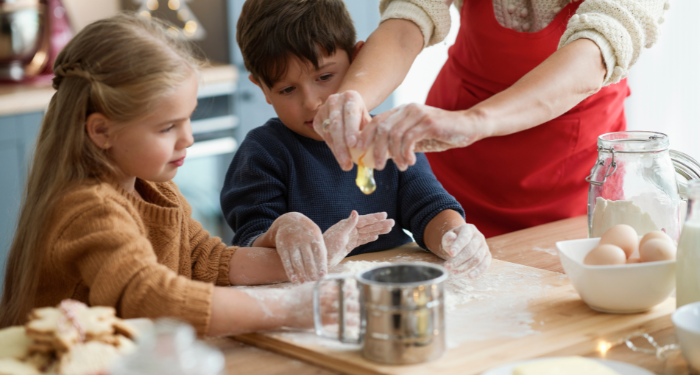
Why Baking Helps Picky Eaters With Smell Sensitivity and Texture Aversion
From a clinical standpoint, baking works because it breaks food into smaller, safer actions.
Many children with food texture aversion cannot jump straight to biting and chewing. But they can watch, pour, stir, scoop, press, or smell from far away. Those steps still count. They build learning, regulation, and trust.
Baking also has built-in structure:
- A clear beginning
- A predictable sequence
- A clear end
For kids who feel anxious around food, knowing what comes next matters. “First we mix, then we scoop, then we bake, then we clean up” is a plan and plans reduce surprise. Less surprise usually means less panic.
Smell sensitivity is another reason baking is such a useful home practice. Smell can feel overwhelming and instant. Baking lets families control smell like a volume knob:
- Keep ingredients closed
- Open for one second, then close
- Increase distance
- Use lids or crack a window
That level of control makes baking one of the most effective smell-sensitivity activities to recommend.
There’s also the job factor.
“Be the Sprinkle Boss” feels very different than “Try this.” When kids have a role, tolerance often increases, even though the sensory input hasn’t changed.
When caregivers say, “But they didn’t eat anything,” you can redirect them to what did happen:
- Stayed in the kitchen
- Watched the mixing
- Scooped with a spoon
- Smelled from across the counter
Those are real steps. Those steps are the foundation.
The Low-Pressure Exposure Rule (What to Do and What to Avoid)
When pressure shows up, progress usually leaves.
Low-pressure exposure means the child has control over their body and choices. The goal is to teach the nervous system: “I can be near this and I’m safe.” If a child feels trapped, the brain learns the opposite and will fight harder next time.
This is low-pressure food exposure at home, in plain language: invite, don’t force.
You can coach caregivers to use calm, boring language. Boring is good. Boring is safe. Boring doesn’t sound like a test.
Helpful phrases include:
- “You can watch or help.”
- “You can smell from far away.”
- “Hands can stay clean today.”
- “You can stop when you’re done.”
On the flip side, certain phrases escalate fast:
- “Just one bite”
- “You liked it last time”
- Sneaking foods
These break trust even when the child can’t explain why.
Low-pressure does not mean no boundaries. The routine still holds:
- Food stays on the table
- We sit while we bake
But participation is flexible. That’s where growth happens.
A coaching line that sticks:
“We’re building comfort, not compliance.”
A Simple Sniff–Touch–Taste Ladder for Smell & Texture Exposure
This ladder gives clinicians a concrete way to set realistic goals and measure progress beyond bites.
Families need a plan they can remember when the timer is beeping and someone is melting down. A ladder turns “eat it” into manageable steps.
Kids can stop at any step and it still counts.
Sniff–Touch–Taste Ladder
- Look (container closed)
- Be near (same room)
- Smell from far away
- Smell close
- Touch with a tool (spoon, whisk)
- Touch with one finger (quick poke)
- Touch with whole hand (short squeeze)
- Kiss or lick (optional)
- Tiny taste (optional)
- Bite/chew/swallow (optional)
Coach families to aim for one rung per day, not the whole ladder.
If the child is calm, step up.
If the child is stressed, step down.
That’s regulation-based exposure.
Sensory-Friendly Cookie Activity: Grading Sticky Textures
Cookie dough is a full sensory event, sticky, cold, squishy, bumpy. For kids with texture aversion, sticky hands can feel overwhelming.
The fix isn’t “push through.”
The fix is make the step smaller.
Clinical setup tips:
- Use a tiny portion in a small bowl
- Keep wipes, towel, and sink visible
- Start with tools only
Progressions might include:
- Watching
- Scooping with a spoon
- Fork marks (press → lift → done)
- One-finger poke with immediate wipe
Grade difficulty slowly:
tool → finger
cold dough → warmer dough
parchment barrier → direct contact
Staying regulated in the kitchen is progress even without eating.
Adjustments for Kids Who Get Overwhelmed
When kids melt down, the answer is usually smaller step, not bigger push.
For smell overload:
- Increase distance
- Use lids
- Short open-close exposures
- Crack a window
For touch overload:
- Tools first
- Barriers like parchment
- Tiny portions
- “Touch then wipe” routines
For kids who hate surprises:
- Same recipe
- Same order
- Same routine
Ending early can be smart. Stopping before dysregulation teaches the brain: “This ends safely.”
When to Recommend Feeding Therapy Support
Baking and similar activities can be helpful but it’s not always enough on its own.
Consider additional support when you see:
- Very limited diet with no growth
- Extreme smell sensitivity (can’t be in the room)
- Frequent gagging or vomiting
- Intense fear around food
- Medical red flags (choking history, coughing with drinks, pain, poor growth)
Baking still fits but best within a bigger plan: skills, routines, regulation, medical comfort, and caregiver coaching.
FAQ
How do I help a child tolerate new food smells?
Start with distance and control. Keep food closed. Open briefly. Let the child choose proximity. Praise calm participation.
What are sensory-friendly cooking activities for picky eaters?
Stirring, pouring, sprinkling, scooping, pressing fork marks, placing items on trays. Baking works well because it’s predictable.
How do I introduce sticky textures without a meltdown?
Use tools first. Use tiny amounts. Show the cleanup plan before starting. Try “one poke then wipe.”
Conclusion
Sensory-smart baking gives clinicians a powerful, real-life way to help picky eaters practice smells and textures without pressure. Cookies are ideal for grading sticky textures. Cocoa works well for smell tolerance and warm-wet exposure.
Keep it low-pressure.
Let the child choose the step.
Repeat the same routine often.
And if the cookie dough ends up on someone’s elbow? That’s just proof it was real life—not perfect—and that’s where learning actually happens.