I get this question constantly, and the answer is blunt. No. Snoring is never normal in a child, and I want to be direct about why that matters.
It is common. Depending on how a study defines it, somewhere between a quarter and a third of children snore at least occasionally, and habitual snoring, meaning three or more nights a week, runs closer to 7 to 12 percent. But common and normal are not the same thing. I hammer on this constantly, because providers and parents use “common” as a reason to wait and see, and waiting costs kids months or years of fragmented sleep during the most critical window for brain development.
What is actually happening when a child snores
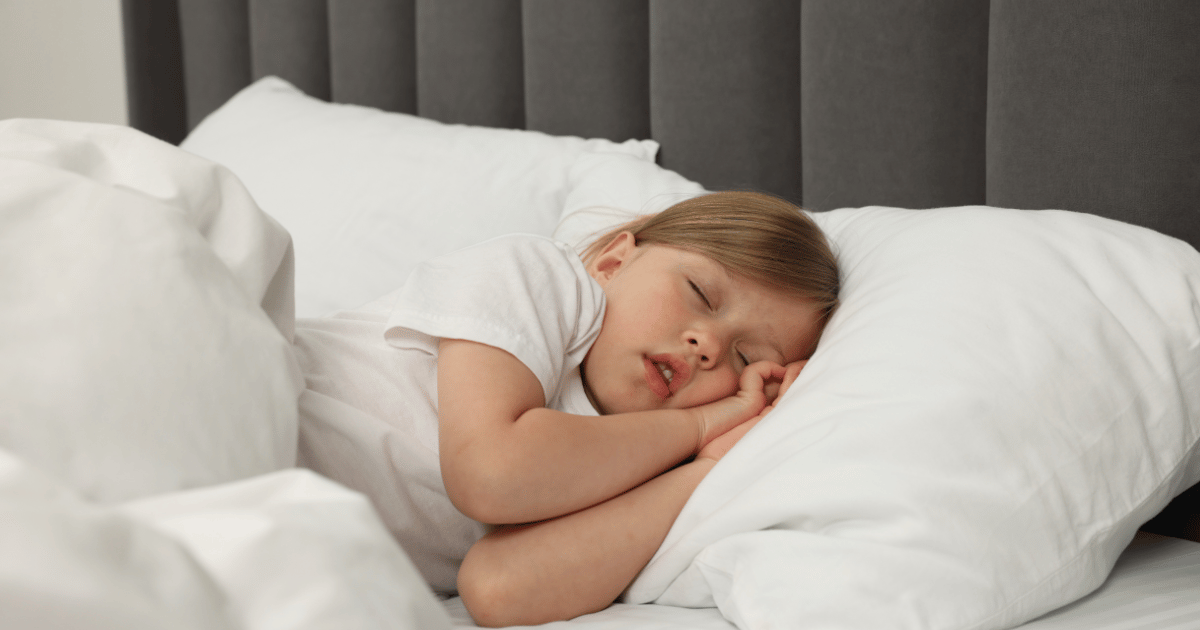
Snoring is the sound of turbulent air moving through a narrowed airway. The sound itself is the evidence. Something is restricting airflow while the child sleeps.
Here is what follows from that. Their sleep is broken, even if they are never fully waking up. The restorative phases, the deep stages where the brain consolidates memory, processes learning, and restores itself, keep getting interrupted. A child can sleep “all night long” on the surface and still be getting terrible quality sleep underneath, because the snoring indicates airway compromise.
This is the reason parent report is so unreliable here. Parents are not withholding anything. They are describing what they can see, which is a child who stays in bed. Quantity of sleep is visible. Quality of sleep is not.
One fair distinction: a child who snores for a few nights with a cold is a different situation. Transient snoring during an upper respiratory infection is common and usually resolves with the illness. What matters is loud snoring that shows up most nights and persists outside of illness.
The learning connection
The research backs this up, and it is not subtle. Community studies of school-aged children consistently find that habitual snorers perform worse academically than children who never snore, with roughly two to three times the odds of poor performance in subjects like math, science, and spelling.
The finding that should make every clinician sit up straight is that this holds even for children whose sleep studies come back clean. Primary snoring, meaning snoring without measurable apneas on polysomnography, has historically been treated as benign by definition. A community study of over 1,100 primary school children published in Sleep and Breathing found children with primary snoring had significantly more hyperactive and inattentive behavior and worse school performance than children who had never snored, with odds ratios close to those of the children who had actual obstructive sleep apnea.
This work is observational, so it does not prove the snoring caused the difficulty. It does mean a normal sleep study is not the same thing as a normal night of sleep, and it means “just snoring” is not a clean bill of health.
The cascade I see in practice
You have a child snoring at night, and by day they present as hyperactive, inattentive, aggressive, cranky. Teachers flag attention concerns. Parents bring them to you thinking it is sensory or ADHD.
But the root is sleep, and specifically the quality of it, not the quantity. The brain regions responsible for learning and memory, the hippocampus and the frontal cortex, are not getting the restoration they need. That is happening across the years those systems are still being built, so it compounds.
Worth saying plainly, because it gets flattened in the shorter version of this conversation: this does not mean every inattentive child has an airway problem, and it does not mean a real ADHD diagnosis is wrong. The two co-occur. Your job is not to overturn a diagnosis. It is to make sure the airway got looked at before anyone settled on an explanation.
The child who taught me to stop ignoring it
I walked into a preschool classroom once and heard a two-year-old snoring like a middle-aged man, asleep on the floor at nap time. The teachers had completely normalized it. It had been happening since her first day, so it had become part of who she was to them.
I flagged it with the director as a safety concern. It turned out to be obstructive sleep apnea. That child ended up needing an emergency sleep study and an emergency tonsillectomy.
Afterward, her parents told me she used to sleep through the night and never woke them up. That was the reassurance everyone had been operating on. And she was the child turning around at circle time, not responding to her name, seeming out there in her own world, because her sleep quality was abysmal.
Not every snoring child is that child. But that child existed in a room full of adults who all had a reasonable-sounding explanation, and not one of them involved her airway.
Some children snore so quietly that parents think it is cute. I have seen kids with what looks like a closed mouth during the day whose airways are compromised at night. Volume is not the measure of severity.
What to actually look for
At night
- Habitual loud snoring, not just when they have a cold
- Pauses or gasps for air, where breathing stops and the child jolts back into it
- Restless sleep, thrashing, covers on the floor, ending up sideways or at the foot of the bed
- Unusual head positions, head thrown back, chin lifted, propped up or nearly sitting
- Night sweats with no fever and a cool room
- Bedwetting, especially in an older child who had been reliably dry
During the day
- Behavioral issues and difficulty with attention
- Headaches, irritability, and daytime sleepiness
- Mouth breathing and a nasal or muffled voice quality
- Learning struggles that do not match the child’s apparent ability
What to do if you are seeing these signs
Start screening. You do not need new equipment or a new credential to do any of this.
- Ask parents specific questions. Not “how does she sleep.” Ask what she sounds like, how many nights a week, whether it happens when she is not sick, and whether they have ever heard her stop breathing, gasp, or snort.
- Have them record a few minutes of sleep. Video with audio, ideally an hour or two after she has fallen asleep, when the patterns are clearest. It costs a family nothing and it is the highest-yield thing you will ask for.
- Talk to teachers about what they observe at school. Nap time is a free observation window, and staff will often confirm something a parent has never heard.
- Look at the airway picture. Enlarged tonsils, a narrow palate, a tongue tie, chronic congestion. None of it is diagnostic on its own, and all of it changes how hard you push.
Then refer appropriately
- ENT for structural involvement, particularly adenoids and tonsils
- A myofunctional therapist or airway-focused dentist to address the breathing pattern and oral resting posture
- Feeding therapy if they are younger, where the work lives inside oral resting posture, lip closure, and chewing patterns
- Sleep medicine when the history warrants polysomnography, which remains the diagnostic standard
Sequencing matters. Myofunctional therapy does not shrink tonsils and it does not open a blocked nose. Asking a child to hold a nasal breathing pattern when he physically cannot move air through his nose sets him up to fail. Myo’s job is restoring and maintaining nasal breathing and oral resting posture once the obstruction is being addressed.
The fix usually is not sleep training
The fastest, healthiest fix is often not sleep training. It is restoring nasal breathing and proper oral resting posture so the airway is stable and the child actually gets restorative sleep.
So, is snoring normal in children? No. It is not cute and it is not a personality trait. It is the sound of a child working harder to breathe than she should have to, night after night, during the years her brain is doing its most important work.
The next time a parent mentions it on the way out the door, stop them.
If this has you rethinking a few kids on your caseload, that is exactly the point. Learning to read feeding, speech, myofunctional therapy, and airway as one connected picture instead of four separate referrals is what The Integrated Therapist™ is built for. It is a year-long clinical mentorship for SLPs, OTs, and PTs, with weekly live calls where you bring the case that has been nagging at you and work it through with mentors who treat this every day. If you want to stop letting comments like that one walk out the door, that is where to go deeper.